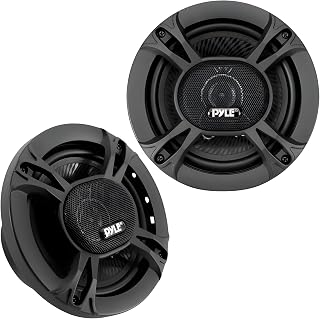
Car coaxial speakers come in round and oval formats, with a tweeter mounted over the woofer; some add further drivers to divide up the sound frequencies. Component speaker sets separate the tweeter from the woofer, so they suit an installation with separate mounting locations, while coaxials combine those drivers at one location. Start with the shape and mounting space at each position you want to replace, since front doors and rear locations can require different speakers.
Nominal speaker size is the starting point for fit. Among the 6 products that list speaker size, most fall between 3.8 and 6.5 inches, and 6.5 inches is typical.. Compare the speaker’s cutout dimensions, mounting hole pattern and mounting depth with the vehicle’s opening and available clearance. A speaker can match the stated size yet have a magnet that obstructs a lowered window or a protruding tweeter that touches the factory grille. If an adapter ring is needed, account for how it moves the speaker toward the door trim. Vehicle labels such as Car and Truck cannot resolve these details; look for fit information covering your vehicle’s year, model, trim and intended speaker location.
Next, match the electrical requirements to the factory stereo or amplifier that will drive the speakers. Speaker impedance must be supported by that equipment, especially where a factory system uses unusual loads or dedicated amplifier channels. Compare continuous power handling with the amplifier’s continuous output at the same impedance; maximum output power is not a useful substitute for this comparison or a prediction of loudness. For a modestly powered stereo, sensitivity can help distinguish speakers that need less power to reach a given level, but compare ratings measured under the same conditions. Usable volume also depends on the source signal, amplifier distortion and installation.
Before ordering, establish whether the factory wiring carries a full-range signal to each replacement location; a channel filtered for a woofer may leave the coaxial tweeter with little treble to reproduce. Identify the required wiring harness and any factory connectors that must be retained, and check whether harnesses, adapter rings, mounting screws and grilles are supplied or sold separately. For door installations, follow the vehicle’s requirements for retaining moisture barriers and keeping drain paths clear. The speaker listing or manual should also identify any supplied sealing gasket and explain how to seal the speaker against its mounting surface.
How we list products: every listing here has a recorded price, a minimum customer rating and enough ratings or monthly sales. Generic and unbranded listings are left out; every real brand stays, including brands sold only on Amazon. Products are ordered by monthly searches for their brand and model on every page.Editorial policy